
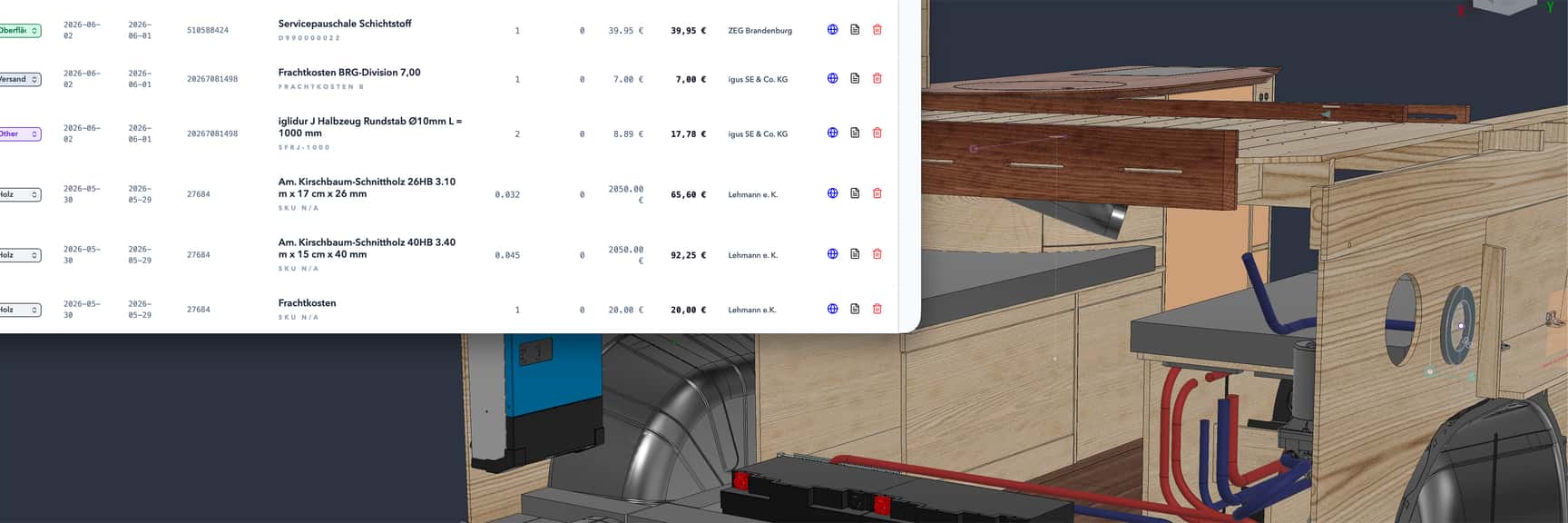
Especially with a bespoke conversion, the cost range is wide, and I can only give you a precise estimate once I have gotten to know your project in detail. Still, as a rough orientation: most camper conversions at Feincamper fall between €70,000 and €100,000 (including VAT, excluding the base vehicle).
In the following, I will explain how these costs come about, how they break down, and which factors drive them. All figures are rough guide values, and there are always outliers in both directions.
How the costs of a camper conversion break down
In my experience, the costs split into roughly 1/3 material costs and 2/3 labor. If you have a panel van converted, material costs come to around €20,000 – 35,000. The workload is 100 – 200 hours for planning and engineering, plus 400 – 600 hours for the build. Labor therefore makes up the remaining 2/3 of the total, around €50,000 – 75,000.
Which factors influence the cost of a camper conversion?
Material costs
Material costs vary considerably with a bespoke conversion, because every project is one of a kind. Here are a few examples of factors with a major influence on material costs:
- Vehicle size: a large panel van swallows more material than a small bus.
- Materials: furniture surfaces can cost €10, but also €100 per square meter. The range for upholstery fabrics is even wider. Wood species also vary greatly in price – while pine costs only about €500, olive wood is around €5,000 per cubic meter.
- Off-grid autonomy: every day of autonomy is paid for with more battery capacity, more solar power, or more powerful chargers. A large electrical system that can deliver 230V for several days – for induction cooking, for example – costs considerably more than a simple 12V system that only has to power small consumers.
- Electronics: simple light switches, or a central camper control system that lets you keep an eye on everything remotely? Here, too, the range runs from about €300 to €3,000.
- Wet room: if you want to shower in the vehicle, a wet room has to be built. A shower tray may need to be custom-made, everything has to be watertight, and there will probably be a hot-water system as well. All of that costs considerably more than if a cabinet or a longer kitchen run had taken the wet room's place.
- Winter capability: making a vehicle truly winterproof takes more than a reliable heater and a well-insulated body. The water supply and drainage in particular require considerable extra effort to make sure nothing freezes.
- Attachments: entry steps, awning, roof rack, rear carrier – each of these items adds a four-figure amount to the costs.
Of course, this list is only a small selection to illustrate how the differences arise and why a bespoke conversion initially only allows for a very rough estimate.
Labor costs
More material going into the vehicle usually also means more work. That is why the rule of thumb of 1/3 material to 2/3 labor generally works quite well. But here, too, there are aspects you might not think of right away.
- Vehicle size: as with material costs, there is usually more to do in larger vehicles than in smaller ones.
- Surfaces: some surfaces come from the factory already pressed onto the plywood panel – all that is left is peeling off the protective film. Others are glued on with the vacuum press, sanded, wetted, sanded again, oiled, sanded, oiled...
- Shapes: curves are more elaborate than corners. While a corner just joins two parts, a curve involves many work steps, depending on how and from which material it is built.
- Solid wood elements: while sheet material arrives almost finished, it takes quite a few steps to turn rough sawn timber from the lumber dealer into a beautiful piece of furniture.
- Unusual details: bespoke conversions keep bringing special requirements that you do not build every day. That is a wonderful challenge – but it also involves development work.
How much will your bespoke conversion cost?
I am happy to give you a rough cost estimate for your project. As you can probably guess by now, I first need quite a bit of information from you. So I recommend booking a non-binding consultation or filling out the conversion questionnaire. You will find both on the contact page.